Emissions
New WRN is minted every weekly epoch on a fixed, programmatic schedule. Each epoch's mint is split three ways:
- Base emission → gauge rewards distributed to LPs via gauges, directed by voting.
- Rebase emission →
bWRNlockers' dilution protection: it accrues to thebWRNvault so lockedWRNis not diluted by base emissions. - Protocol Sustainability emission → tops up the Operations Reserve (treasury). See WRN.
Issuance starts from an initial supply of 1,000,000,000 WRN (see WRN) and expands each epoch to fund these incentives.
Emission phases
The base emission follows a three-phase curve. Each phase sets the base emission as a percentage of the current total supply, so absolute issuance compounds as supply grows.
| Phase | Weeks | Behaviour |
|---|---|---|
| Growth | 1 – 56 | Starts at 0.5% of supply in week 1 and the base amount compounds at +2% per week, until it reaches the 1% of supply cap. |
| Decay | 57 – 166 | After the peak, the base amount decays at −1% per week. |
| Tail | 167 onward | A permanent floor of 0.2% of supply per week. |
The schedule peaks at week 57, where the base emission reaches ~15.08M WRN (a total weekly mint of ~17.72M WRN) before entering the decay phase.
Per-epoch mint
Each epoch's total mint is the base emission plus a rebase and a Protocol Sustainability emission derived from it:
With the launch parameters below, the rebase equals Base × 0.125 (12.5% of the base emission) and the Protocol Sustainability emission equals Base × 0.05 (5% of the base emission).
| Parameter | Value | Role |
|---|---|---|
| Initial weekly emission rate | 0.5% of supply | Base emission in week 1. |
| Weekly growth rate | +2% / week | Compounds the base amount during the Growth phase. |
| Peak emission cap | 1.0% of supply | When the base reaches this, the phase switches to Decay. |
| Weekly decay rate | −1% / week | Compounds the base amount down during the Decay phase. |
| Tail emission floor | 0.2% of supply | Permanent minimum base emission (Tail phase). |
Lock rate (bWRN/WRN) | 0.5 | Assumed share of WRN locked as bWRN; sets the rebase size. |
| Protocol Sustainability rate | 5% of base | Tops up the Operations Reserve (treasury). |
The rebase is what makes bWRN non-dilutive relative to base emissions: as WRN inflation accrues to the deposit-only vault, each bWRN share is backed by more than 1 WRN over time. See bWRN for the vault mechanics.
Modeled multi-year supply
The outlook below is modeled from the launch parameters — figures are illustrative, since realized issuance each epoch depends on the live supply. Assumes a constant 50% burnt supply rate.
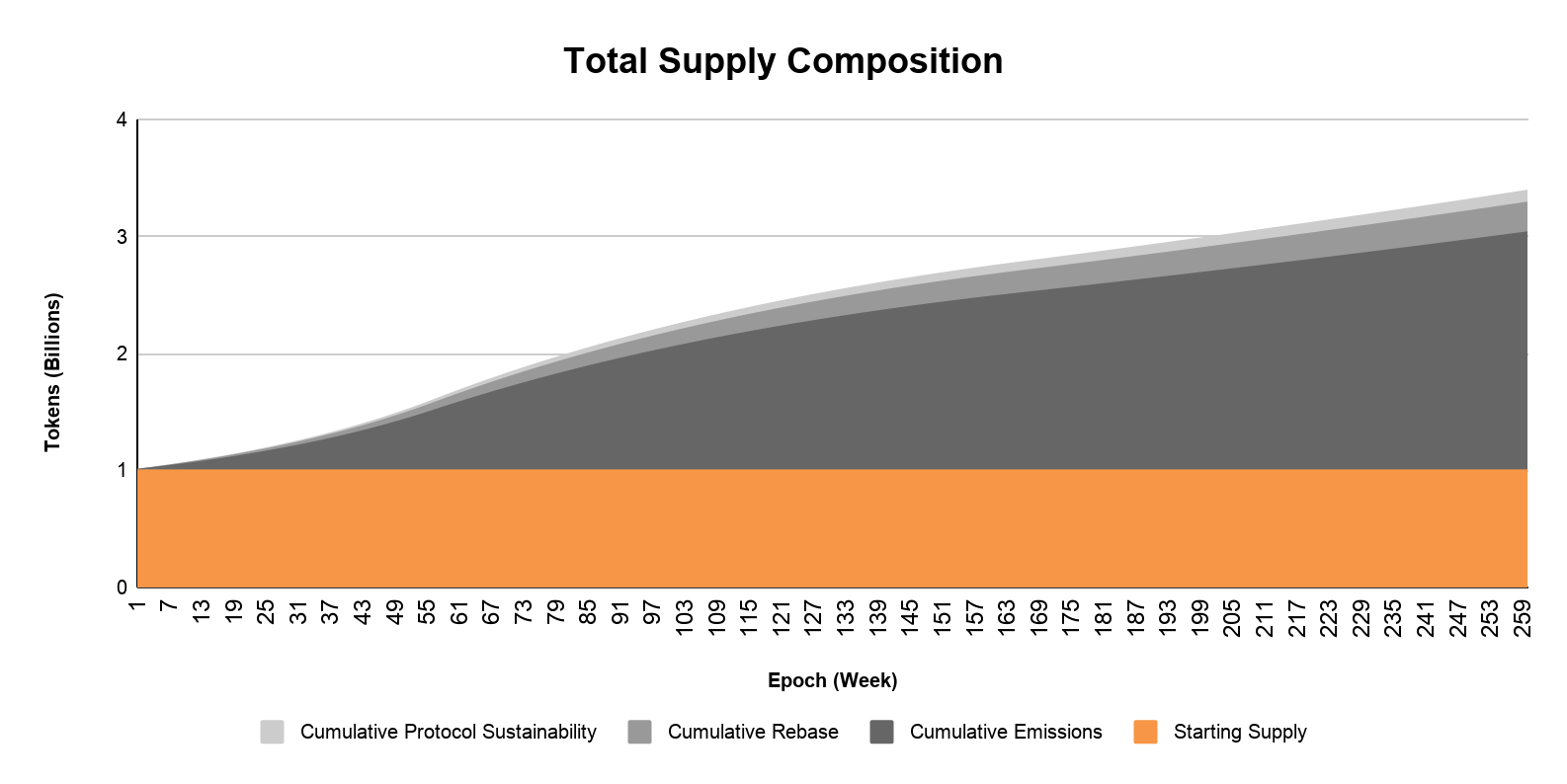
| Year | Phase at year-end | Cumulative issued (≈) | Total supply (≈) | × initial |
|---|---|---|---|---|
| Initial (TGE) | — | — | 1.00B | 1.00× |
| 1 | Growth (peak) | 0.61B | 1.61B | 1.61× |
| 2 | Decay | 1.27B | 2.27B | 2.27× |
| 3 | Decay | 1.72B | 2.72B | 2.72× |
| 4 | Tail | 2.04B | 3.04B | 3.04× |
| 5 | Tail | 2.39B | 3.39B | 3.39× |
These projections come from the launch emissions model. They are not a guarantee of future supply — actual issuance each epoch is computed from the live supply at that epoch.
How emissions are directed
Base emissions do not flow to pools automatically — bWRN holders direct them each epoch.
- Gauges are the unit through which emissions reach a pool's LPs.
- Voting determines how each epoch's emissions are split across gauges.
- Liquidity Rental lets external protocols deposit vote incentives to direct emissions toward their pools.